 Wildlife
of Sumatra
Wreathed Hornbill
Hornbills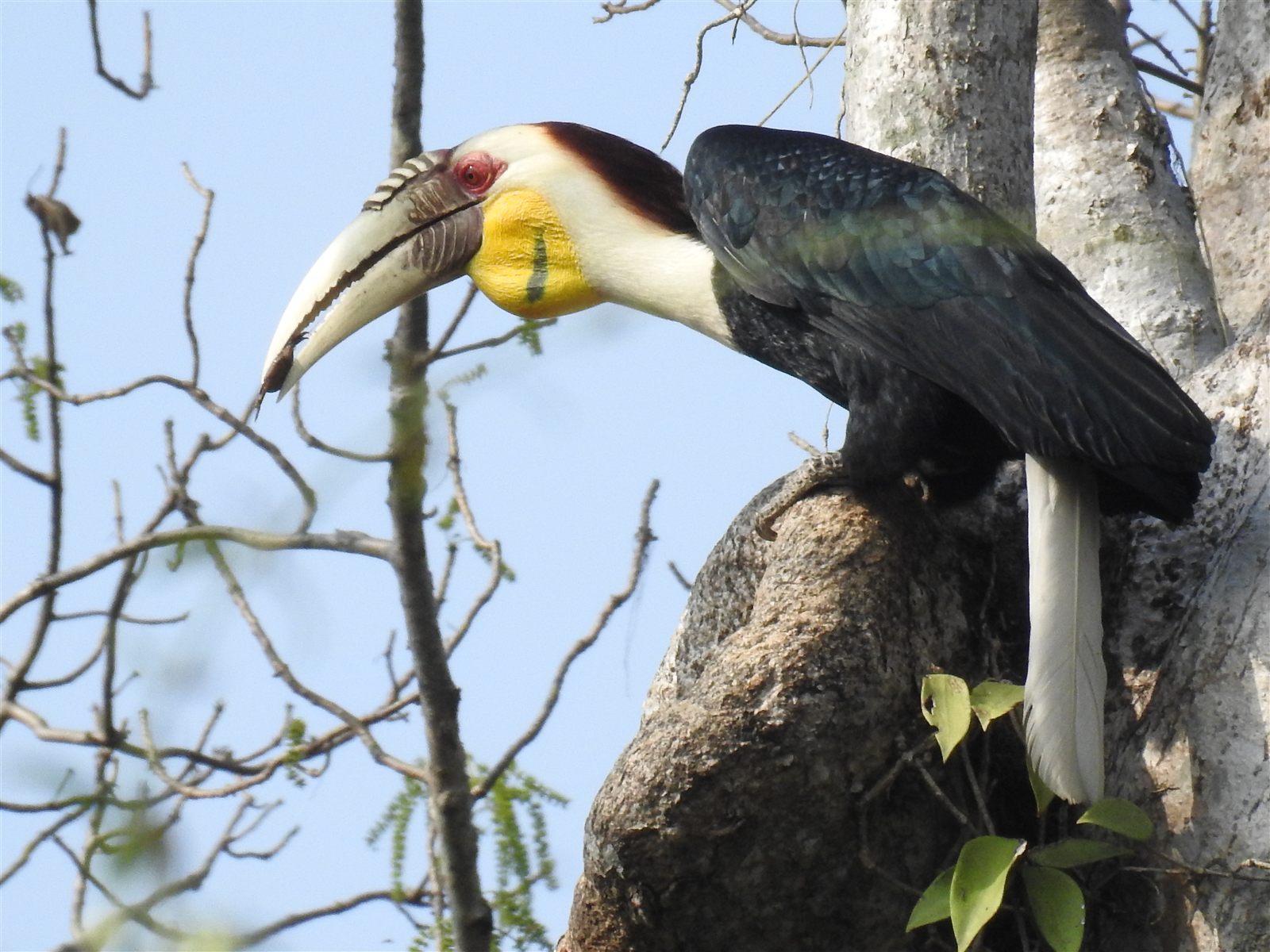
Photo: Aparajita Datta · CC BY-SA 4.0 (May be cropped or resized)
Rhyticeros undulatus
Basic stats
Diet
Mainly large fruits, swallowed whole
Habitat
Tropical evergreen forest, up to about 2,560m; nests 18–28m above ground
Range
Southern Bhutan, north-east India and Bangladesh through mainland Southeast Asia to the Greater Sundas
Size
75–90cm
Weight
Males 1.68–3.65kg; females 1.36–2.69kg
The wreathed hornbill is a medium-sized hornbill 75–90 cm long; males weigh 1.68–3.65 kg and females 1.36–2.69 kg. Males are black with a rufous crown, a white upper breast and face and a bright yellow featherless throat, while females are uniformly black with a blue throat and are slightly smaller. It is also called the bar-pouched wreathed hornbill for the distinctive blue-black band on its lower throat sac, and is named for the ridges, or wreaths, on the casque (Wikipedia, general species account).
It ranges over the foothills and evergreen forests of north-east India and Bhutan to Bangladesh, mainland Southeast Asia and the Greater Sundas. It is a frugivore that feeds mainly on large fruits, swallowing them whole and so dispersing seeds over long distances. It travels far to forage, sometimes flying between islands, but does not migrate. It is threatened by hunting, habitat fragmentation and deforestation (Wikipedia, general species account).
Quick answers
- What does the Wreathed Hornbill eat?
- Mainly large fruits, swallowed whole
- What habitat does the Wreathed Hornbill live in?
- Tropical evergreen forest, up to about 2,560m; nests 18–28m above ground
- Where is the Wreathed Hornbill found?
- Southern Bhutan, north-east India and Bangladesh through mainland Southeast Asia to the Greater Sundas
- How big is the Wreathed Hornbill?
- 75–90cm
- How much does the Wreathed Hornbill weigh?
- Males 1.68–3.65kg; females 1.36–2.69kg